
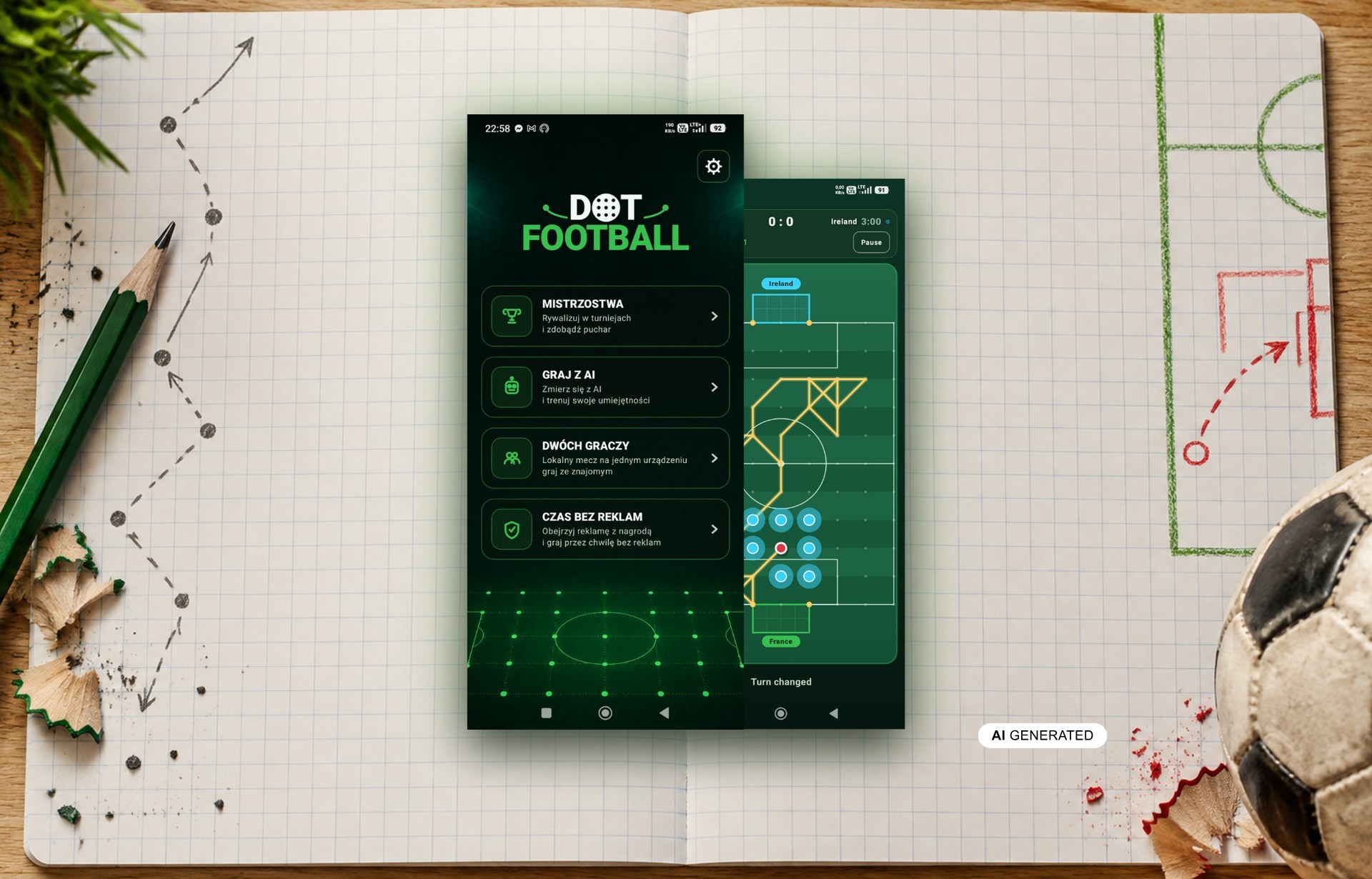
DotFootball is a mobile game for Android that brings classic dot football, also known as paper soccer, from the squared notebook to your phone screen. It was made by BeeClear, a developer of WordPress plugins and smartphone apps. One of its game modes is a match against the computer, which offers three difficulty levels: Easy, Medium and Expert. Plenty of beliefs surround an opponent like that, from “the computer always wins” to “you can’t play without internet”. We check them one by one against how the artificial intelligence in DotFootball actually works.
Table of contents
- Is dot football too simple for a computer to calculate anything?
- Does the computer always win in DotFootball?
- Does the Easy level just make random moves?
- Is the Expert level in DotFootball impossible to beat?
- Does one wrong tap on a phone screen ruin the match?
- Does playing the computer come down to reflexes and a ticking clock?
- Do you need an internet connection to play the computer?
Is dot football too simple for a computer to calculate anything?
Dot football is simple only in its rules, because every match gives plenty to calculate. The pitch is a grid of dots, 8 by 10 squares, and the ball can move in any of eight directions. A line once drawn can never be used again, so every move changes the rest of the game. Then there are bounces off the boundary, a post or a visited dot, after which the same player moves again. Chains of bounces create multi-step plays, and a single move can open or close the path to goal.
That is why the AI in DotFootball doesn’t guess but works through the options. It runs a minimax algorithm with alpha-beta pruning. The algorithm checks possible sequences of moves for both sides and picks the one that suits it best. Along the way, it cuts off branches that cannot lead to a better result. When scoring a position, it also weighs the distance to the outcome, so a goal close at hand counts for more than a distant one.
Does the computer always win in DotFootball?
The computer in DotFootball doesn’t always win, because you choose its strength yourself before the match. The game offers three difficulty levels, and each higher one means a deeper-thinking opponent. The difference lies in how far ahead the algorithm analyses the board. Medium is the default, and you can change it on the match setup screen. That way you match the difficulty to your form instead of facing the toughest opponent at once. Here is how the levels compare:
| Level | Look-ahead | Best for |
|---|---|---|
| Easy | 4 moves ahead | a friendly start for new players |
| Medium (default) | 6 moves ahead | a challenging but balanced match |
| Expert | 8 moves ahead | a real challenge for experienced tacticians |
In Championship mode, the look-ahead also grows with the strength of the opposing national team, up to eight moves. The AI there never plays weaker than in a regular match at the same level. A stronger opposing side simply means a tougher game.
Does the Easy level just make random moves?
The Easy level doesn’t make random moves, because the algorithm analyses the pitch here too. It checks options four moves ahead and steers the ball towards the goal it attacks. It also won’t hand you a goal on a plate, meaning it doesn’t leave you a one-move score. For a new player, it is an opponent you can beat and learn from at the same time. You watch how the machine builds a play, and you soon start doing the same.
A shorter horizon has its limits, though. A longer bounce combination goes beyond the four moves the weaker opponent can see. That makes Easy a good place to practise bounce corridors and blocking the way to goal. Once you start winning regularly, move up to Medium.
Is the Expert level in DotFootball impossible to beat?
The Expert level in DotFootball is the toughest opponent in the game, but it follows the same rules as you. At this level, the algorithm checks options as far as eight moves ahead. An AI set up like this is a real challenge even for experienced players. Still, it can’t reuse a line that has already been drawn or take the ball off the pitch. If it has no legal move on its turn, it loses the round just like a human would.
Beating Expert takes thinking several steps ahead, not quick reflexes. Plan your bounce corridors and shut off your opponent’s path to goal without blocking your own moves. A ball trapped with no way out sinks the machine just as surely as your old classmate. Easy rules, hard to master – that sums up this level best.
Expert also has to hit the exact centre of the goal line, because only then does a goal count. It can’t score by sliding the ball along the edge of the goal or by cutting a corner from outside the goal mouth. An own goal always counts for the other side, and that costs the machine as much as you. Equal rules mean equal chances, and the quality of the plan decides the result.
Does one wrong tap on a phone screen ruin the match?
One wrong tap on a phone screen doesn’t ruin the match, because DotFootball checks that every move is legal. Allowed dots are large, with a white outline ring and a pulsing halo. The app maps your tap to the dot under your finger, and the current turn’s moves glow brighter than the older trail. The game also won’t let you move the ball along the pitch outline or off the board. In a notebook, players police the rules themselves, while here the game engine does it.
A few other interface touches help in a match against the AI:
- during your turn, an undo option appears for moves made in the current bounce chain,
- undo never reaches past the move that ended a turn or back into a previous round,
- during the computer’s turn, the app ignores taps and shows that the AI is thinking,
- a status message below the board tells you whether a bounce lets you continue or a goal was scored.
These safeguards matter most in a bounce chain. In a run of several moves by one player, it is easy to slip. Undo lets you fix a badly built combination before play passes to the other side. What you can’t reverse is a move that has already ended your turn.
Does playing the computer come down to reflexes and a ticking clock?
Playing the computer in DotFootball doesn’t take reflexes, because the game is turn-based. What counts is thinking one move ahead, not how fast your fingers are. Each player does have their own clock per round, three minutes by default. Running out of time loses the round, so you can’t forget about the clock entirely. Even so, three minutes leaves plenty of room to think your bounces through calmly.
When you need a breather, hit pause. The pause overlay stops the clock and locks the board, and from there you can resume or exit the match. The system Back button asks for confirmation, so an accidental press doesn’t end the game. A match runs to three goals by default and lasts from a few minutes to a dozen or so. That fits nicely into a short coffee break.
Do you need an internet connection to play the computer?
You don’t need an internet connection to play the computer, because DotFootball works fully offline. Your virtual opponent is ready on a train or in a waiting room with no signal. You don’t have to create an account or sign in either. The game is free and shows ads, but no paywall locks the core gameplay. Your first match is always ad-free, and watching a rewarded ad gives you extra ad-free playing time.
DotFootball also speaks your language, with full localisation into 30 languages. You change the language in Settings, and the whole interface switches at once. The game remembers your choice, so you don’t have to set it again next time. The look is minimal and clear, focused on the board itself. It is the same game from school, only with an opponent ready at any hour.
You’ll find the rules, all game modes and screenshots on the DotFootball game page. Start on Easy and raise the bar once bounces become second nature. Expert will wait for you patiently. The kick-off is entirely your call.