
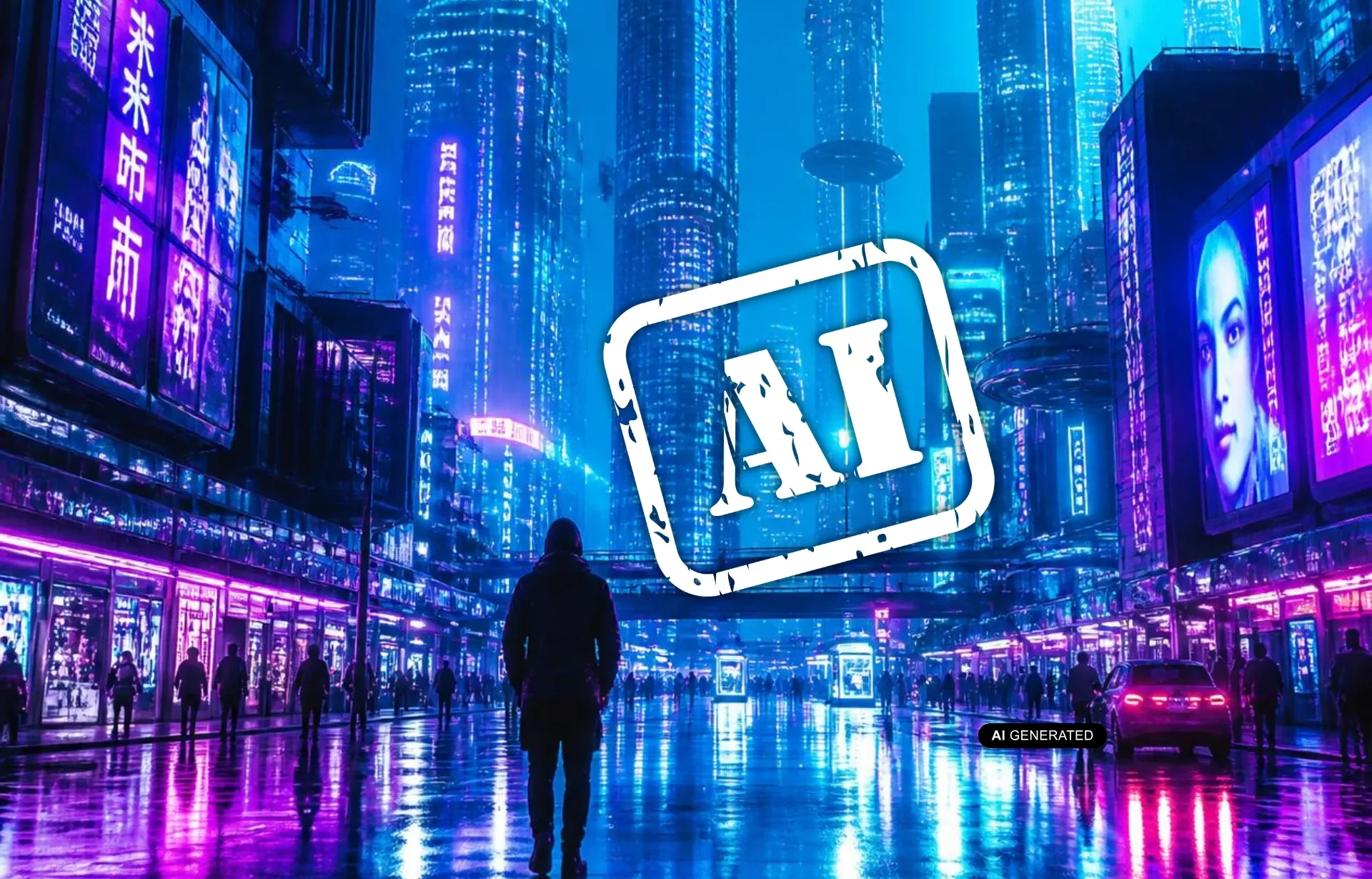
A lot of fear has built up around the EU’s AI Act: “now every AI image needs a visible label.” In practice, the law is much narrower – a visible “Generated by AI” marker applies almost exclusively to photorealistic material that passes itself off as reality in an informational context. Below, we break the myths apart and show how graphics and text are actually labeled today.
Table of contents
- Where did the myth that every AI image needs a label come from?
- What does the AI Act actually say about labeling?
- How are images and text technically labeled?
- Does animating a background (water, air, a cinemagraph) require a marker?
- Do digital actors in a film need to be labeled?
- When is a visible marker on an image actually needed?
- How is the AI Act different from copyright law?
Where did the myth that every AI image needs a label come from?
The myth that every AI image needs a label comes from an oversimplification of Article 50 of the AI Act. The transparency obligation covers content that could mislead the viewer about whether they’re looking at real or generated material. That’s a very different thing from “anything AI ever touched.” Technical assistance, design work and authorial work stay outside the scope of visible on-frame labeling.
Redrawing your own screenshot as a vector – by hand or with the help of an AI tool – is authorial work or technical assistance, and the AI Act doesn’t cover it. Any technical metadata (such as C2PA) gets embedded by the software, for example Adobe, not by the creator. Day to day, this “no visible marker” group typically includes:
- icons, logos and vector illustrations assembled in an editor,
- UI mockups and diagrams traced from your own screens,
- AI-assisted retouching, cropping and color correction,
- decorative graphics that don’t pass themselves off as real photography.
What does the AI Act actually say about labeling?
The AI Act says less about labeling than the headlines suggest. To work out whether a visible on-frame marker is needed, just run through four questions in order:
- Is the material photorealistic and does it imitate real-world reality?
- Does it appear in an informational context (news, journalism, an official statement)?
- Could a viewer mistake it for a genuine photo or recording?
- Only if you answer “yes” to all of them do you actually need a visible label.
The classic case that does require labeling is a deepfake presented as genuine material. A generated “photograph” of an event, or a fabricated statement from a politician published on a news site, needs a marker. It protects the audience from disinformation.
How are images and text technically labeled?
Technically, images and text are labeled in two complementary ways. The first is invisible metadata embedded in the file; the second is watermarks blended into the content itself. Below, we break down both.
What is C2PA and Content Credentials?
C2PA (Content Credentials) is a standard that attaches a cryptographically signed “manifest” of the creation history to a file. It records which tool created or edited the image and whether a generative model was used, and the signature makes it possible to detect any tampering with the metadata. This layer is invisible to the eye – it lives in the file, not on the frame. In most tools (Adobe Firefly, cameras with CAI support), the software adds it automatically.
How do SynthID watermarks and text watermarking work?
Watermarks are blended into the content itself, alongside the metadata. In images and video (for example SynthID), pixels are modified in a way that’s invisible to a human but detectable by machine. In text, watermarking works by subtly steering the model’s word choices. That leaves a statistical “signature” a detector can read, without changing the meaning of the sentence for the reader.
Does animating a background (water, air, a cinemagraph) require a marker?
Animating a background – rippling water, shimmering air, or a subtle cinemagraph on a banner – doesn’t need a marker when it’s used for decorative or marketing purposes. A banner with an animated background on an offer page gets by without a visible label, and a cinemagraph in a product ad carries the information, at most, in the file’s metadata. The obligation only kicks in once that kind of animation passes itself off as genuine footage in a journalistic context, for example as supposed “footage from the scene.”
Do digital actors in a film need to be labeled?
Digital actors and AI-animated characters in a film don’t need to be labeled on screen. Artistic and fictional works don’t need to be “disfigured” with on-frame watermarks, because they fall under the exception for creative works.
When content is part of a work or program that is clearly artistic, creative or fictional, an appropriate disclosure in a form that doesn’t interfere with viewing is enough – for example, in the closing credits or the film’s description.
Gist of Article 50(4) AI Act (paraphrased)
When is a visible marker on an image actually needed?
A visible marker on an image is only needed when the material passes itself off as reality in an informational context. Here’s how that plays out in typical work situations:
| Work scenario | Visible marker on the image? | Where to put the disclosure? |
|---|---|---|
| A vector made from a screenshot of your own system | No | No requirement |
| Animated water or air (web banner) | No | File metadata (added by the AI tool) |
| AI-animated characters in a film or scene | No | Closing credits / film description |
| Photorealistic deepfake (informational) | Yes | A visible label next to the material |
So the focus falls on context, not on the tool. It isn’t the use of AI that triggers the obligation, but whether the viewer could be misled. The very same generated image can be an illustration with no requirements one time, and a deepfake that needs a label the next.
How is the AI Act different from copyright law?
The AI Act and copyright law are two separate obligations that are easy to mix up. AI transparency answers the question of whether the viewer knows what they’re looking at. Copyright law answers the question of whether you’re unlawfully copying someone else’s interface or work. You can satisfy one obligation and still violate the other.