

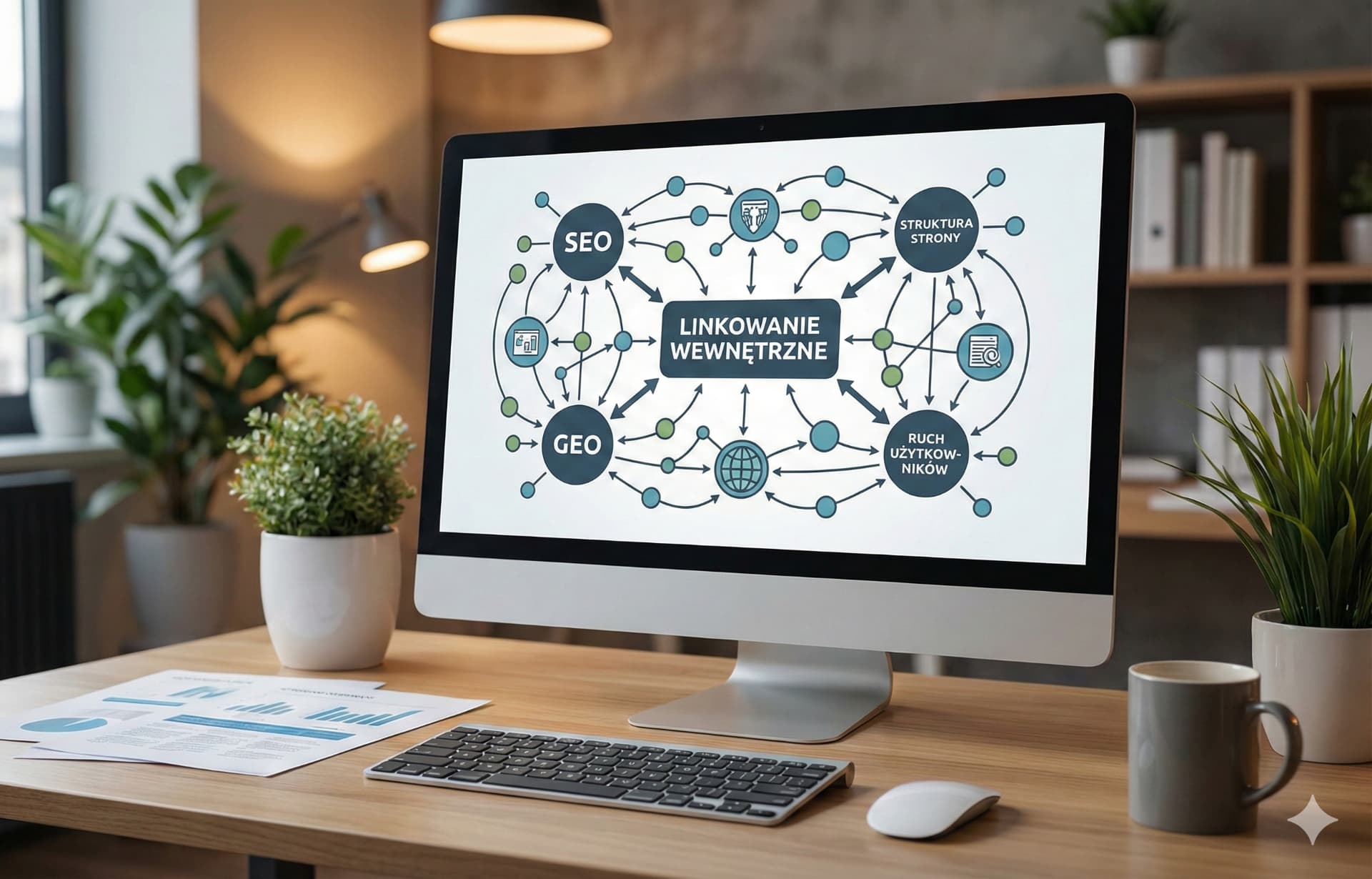
Internal linking is one of the most important, and at the same time most often underestimated, elements of an SEO strategy – both in classic optimisation and in GEO activities. It is the internal link structure that determines how search engine bots move around the site, which pieces of content they consider most important, and how users reach key subpages. In practice, this means a real impact on visibility, conversions and the entire information architecture of the website.
Even though we often focus mainly on external linking, it is internal linking that forms the foundation determining the effectiveness of even the most extensive link-building strategy. A well-designed system of links helps both search engines and users, guiding them through a logical content network and shaping the site’s topical structure. In the GEO context, i.e. local SEO, internal linking also strengthens connections between content related to specific locations, which increases the company’s visibility in regional markets.
How does internal linking affect SEO?
Internal linking helps Google assess which subpages are the most important within a domain. Each link passes on a portion of so-called “SEO power” (PageRank), which can strengthen business-critical pages such as landing pages, product categories or expert articles. As a result, SEO becomes more predictable and the site itself gains a stronger semantic structure. Importantly, well-designed linking also makes it easier to index new subpages, because bots find them faster and return to them more often.
In practice this means that every page on the site has a specific role: some are responsible for education, others for conversion, and others for building expert authority. Internal linking helps to emphasise these roles by assigning them an appropriate place in the hierarchy. Thanks to this, Google sees the site as better organised and more quickly understands its topical relationships, which translates into more precise matching to users’ queries.
Why is internal linking crucial in GEO activities?
In GEO activities, i.e. local SEO, internal linking is even more important than in classic SEO. This is because Google’s algorithms are getting better at understanding geographical context, and every link can strengthen this local network of connections. For example, if you run a company operating in several cities, logically linking subpages like “services Warsaw”, “services Kraków” and “services Wrocław” creates a strong topical-geographical signal. As a result, Google gets a clear picture of your local offer structure, and users can more easily find the information that is relevant to them.
Another advantage of GEO-oriented linking is the building of authority for local subpages. Each location can become a strong point in search results if the internal link network consistently indicates that it is important. The same mechanism applies here as with standard PageRank: a page that is more frequently linked to from other content becomes more visible, and Google reads it as an important element of the site’s structure. That’s why, especially in multi-location websites, internal linking should be carefully planned and based on SILO-type structures.
Internal linking and user experience (UX)
Although the main topic of this article is SEO and GEO, it is impossible to ignore the impact of internal linking on user experience. An intuitive network of links makes it easier to navigate the site, shortens the time needed to reach key information and allows users to discover new content. In practice, this translates into longer sessions, a lower bounce rate and better conversions. Google pays particular attention to these behavioural signals, so higher user engagement indirectly strengthens SEO as well.
A good example is a company blog with numerous expert articles. If a user is reading content about site optimisation, natural additions might be links leading to posts on link-building strategy or local SEO (GEO). Such logical connections increase the chance that the user will stay on the site longer, read more content and come back for more in the future. This, in turn, increases brand awareness and supports the process of building authority.
How to build an effective internal linking strategy?
A linking strategy should be based on a clear logic of relationships between content and on an information hierarchy. The most popular and at the same time most effective approach is the SILO model, in which content is grouped thematically. Each group forms a closed topical area, from which links lead both to parent content and to supporting content. This allows you to build the authority of a specific topic and strengthen it in Google’s eyes. It is particularly important in large websites, expert blogs and for GEO positioning.
- Creating logical topical connections within categories.
- Reinforcing key pages with links from strong articles.
- Using anchors that are varied but related to target keywords.
- Avoiding chaotic or overly repetitive linking.
- Making sure every new piece of content has at least several internal links in and out.
By applying the above rules, you not only gain a stronger site structure but also increase its effectiveness in SEO and GEO activities. The more logical and organised your link network is, the faster Google will understand your content and the goals of your site. What’s more, a properly planned linking strategy makes it easier to scale the website and expand it with new subpages without losing consistency.
The most common mistakes in internal linking
Many websites make mistakes that significantly limit their positioning potential. One of the most common is relying only on links from the menu or footer, which creates a flat structure that is difficult for search engine bots to interpret. Another problem is having too many links in a single article or using anchors that are unrelated to the target content. Such practices can do more harm than good, which is why it’s worth regularly auditing your internal linking.
It is also worth mentioning a flawed approach to local pages. Within GEO, it is often assumed that it is enough to create separate subpages for locations and the rest will “take care of itself”. In reality, these subpages require proper connections, both between each other and with general content. If they are not appropriately integrated into the internal link structure, Google may struggle to determine their importance and their visibility will remain low.
Summary: why is internal linking the foundation of SEO and GEO?
Internal linking, although seemingly simple, is one of the most powerful tools in the hands of an SEO specialist. It shapes the structure of the entire website, helps Google understand its hierarchy, strengthens business-critical subpages and supports local GEO positioning. At the same time, it significantly improves user experience by guiding visitors through a logically connected content network. That is why every professional link-building strategy should begin with a well-thought-out internal link system that grows together with the development of the website.
If you want to improve your site’s visibility, start with an analysis of your current internal linking and consider where you can strengthen connections between content. A well-planned linking strategy can transform the entire structure of your website – get in touch if you’d like us to help you build it professionally and effectively.