
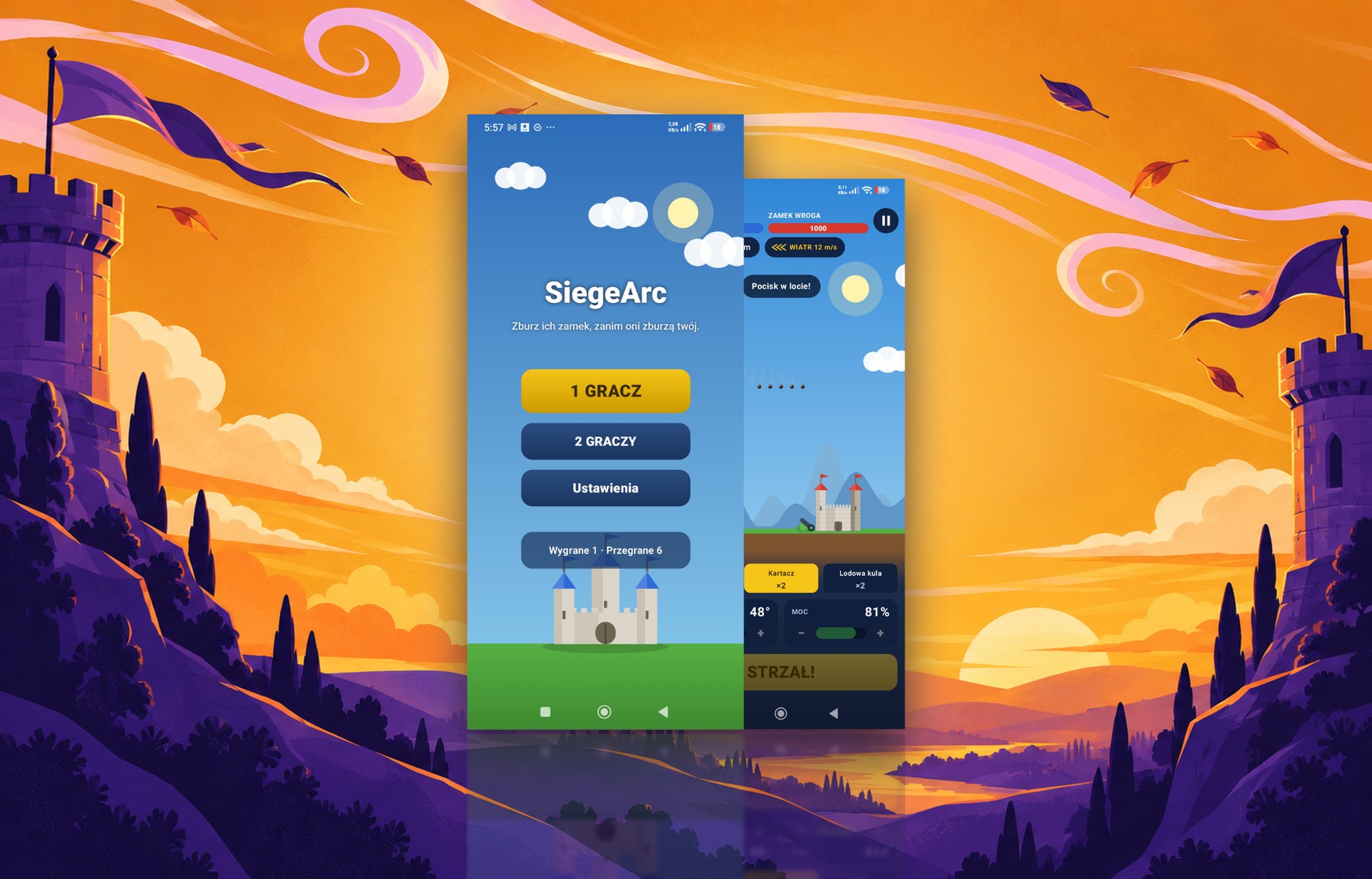
SiegeArc is a turn-based artillery game for Android in which two medieval castles trade fire across rolling hills. It was made by BeeClear, a developer of WordPress plugins and smartphone apps. Every siege comes down to three things: angle, power and a wind that pushes each shot sideways. This guide shows you how to turn that wind from an obstacle into an ally. You will learn how to read it, when to add power and which ammo suits strong gusts.
Table of contents
- How do you read the wind before a shot in SiegeArc?
- When does a tailwind let you lower your shot power?
- Why does the wind matter more at long range?
- High arc or flat shot – which copes better with strong wind?
- Which projectile should you pick in a strong gust?
- How much damage does a bad wind correction cost?
- Fixed or changing wind – which mode should you choose?
- How do you practise shooting into the wind in SiegeArc?
How do you read the wind before a shot in SiegeArc?
You read the wind in SiegeArc from the gauge on the battle screen, before you set angle and power. The game shows both its strength and its direction, and the value always sits between 4 and 15%. The wind blows left or right and pushes the shell for its entire flight. By default a fresh wind is rolled before every single shot. Last turn’s settings are therefore no recipe for the next one.
Build a simple routine: wind gauge first, then angle, then power. Look at the number, not just the arrow. A light 4% breeze needs only a small correction. A gale near the top of the range can shove a cannonball far away from the walls.
When does a tailwind let you lower your shot power?
A tailwind lets you lower your shot power when it blows from your castle toward the enemy fortress. In single-player mode your castle stands on the left and the opponent sits on the right. A wind blowing right therefore carries the shell further than your power setting alone would. At full power you can easily overshoot the walls.
A wind blowing left does the opposite and shortens the flight. When it is in your face, add power or raise the arc so the ball reaches its target. A typical mistake is firing with last turn’s power even though the wind has switched direction. A missed shot does not vanish either, because it blasts a crater in the terrain. That crater reshapes the battlefield for the rest of the game. In a two-player match, remember that a wind blowing right hits the player in the right-hand castle head-on.
Why does the wind matter more at long range?
The wind matters more at long range because the ball stays in the air longer and drifts for longer. By default the distance between the castles is randomised between 500 and 750 metres and changes every game. You can also fix it at 400–800 metres in the settings. The same breeze that nudges a hit along the wall on a short field can blow the ball well past the target on a long one.
So at the start of each battle, check the distance as well as the wind gauge. With the castles close together, a small power tweak is usually enough. At long range, get ready for a bolder correction. Every miss tells you how strongly the wind acts on that particular map.
High arc or flat shot – which copes better with strong wind?
A flat, fast shot copes better with strong wind because the ball spends less time in the air. A ball on a high arc hangs in the sky longer, which gives the wind more chance to push it off course. The flat trajectory comes at a price, though. Between the castles stand 2 to 4 hills, and they stop any ball that flies too low.
Before you pick a trajectory, weigh the terrain and the wind together. In a light breeze you can safely lob the ball over the hills on a high arc. In a strong wind, try a flat “sniper” shot if the hills allow it. Watch the craters from earlier explosions, too. Sometimes they open a low lane straight to the enemy walls.
Which projectile should you pick in a strong gust?
In a strong gust, pick your projectile based on how much you trust your wind correction. SiegeArc gives you three types of ammo with clearly different characters. With limited ammo, each side gets a fixed number of rounds of every type per battle. Here is how each one handles the wind:
| Ammo type | Damage and supply | When to use it against the wind |
|---|---|---|
| cannonball | approx. 22% on a centre hit, 5 rounds | in light or well-read wind, when precision counts |
| cluster shell | up to approx. 15% if all 5 bomblets land, 3 rounds | in strong wind, when you want to cover a wider area |
| ice shell | approx. 10% on a direct hit, 2 rounds | on a reliable trajectory, well away from your own walls |
The cluster shell bursts at the top of its arc into a fan of 5 bomblets. That makes it forgiving of a small wind misjudgement, since part of the spread can still land on the castle. Ice calls for caution. When it strikes the ground, it shatters into 4 shards that skid low both forwards and backwards. If a headwind cuts its flight short, those shards can reach your own fortress.
The cannonball works best once you know how the wind behaves on the current map. It deals the most damage in a single hit, but it does not forgive mistakes. Save it for turns with a light breeze or for a moment when your correction is solid.
How much damage does a bad wind correction cost?
A bad wind correction can cost you as much as 70% of your damage, even when the ball technically hits the castle. SiegeArc rewards accuracy with a bonus based on where the shot lands. A hit dead centre on the base deals full damage, while a hit on the edge of the silhouette deals only 30% of it. A ball pushed a few metres off by the wind still counts as a hit, but it takes far less health off your enemy. A centre-hit cannonball removes about 22% of a castle’s health, so every metre of drift really weakens your shot.
Precision matters even more toward the end of a duel. The more ruined a castle gets, the smaller its silhouette becomes. Finishing off a ruin therefore takes a low, accurate shot with a confident correction. With limited ammo, every point counts for another reason as well. When a side runs out of ammo, the battle goes to whoever dealt more total damage.
Fixed or changing wind – which mode should you choose?
Choose changing wind for excitement and fixed wind for calmly sharpening your aim. Changing wind is the default and rolls a new gust before every shot, so each turn is a fresh puzzle. The tension then lasts right up to the final volley. Fixed wind is set once for the whole game.
With fixed wind, your earlier turns become valuable clues. If the ball dropped short of the walls, add a touch of power next time. If it flew over the castle, ease the power down slightly. Just account for any new craters that may have changed the ground in front of the target.
How do you practise shooting into the wind in SiegeArc?
You practise shooting into the wind in SiegeArc best in a battle with predictable conditions. The settings strip away the other variables so you can focus on the wind. A single battle takes a few minutes, and the game runs fully offline with no account. This training setup works from your very first attempt:
- set a fixed castle distance anywhere from 400 to 800 metres,
- switch on fixed wind so you learn what one wind value does,
- turn on unlimited ammo, which means every battle ends with the walls coming down,
- pick the Easy AI level so you can practise without pressure.
Once you hit consistently, switch back to random distance and changing wind. Then raise the difficulty to Normal or Hard. Wins and losses are saved permanently in the menu, so you can track your progress.
In SiegeArc, the siege goes to the player who treats the wind as tactics rather than bad luck. Read the gauge before every shot, match power and trajectory to the direction, and match your ammo to the strength of the gust. You will find game details and screenshots on the SiegeArc app page. Check the wind, set your angle and bring down their castle before they bring down yours.