
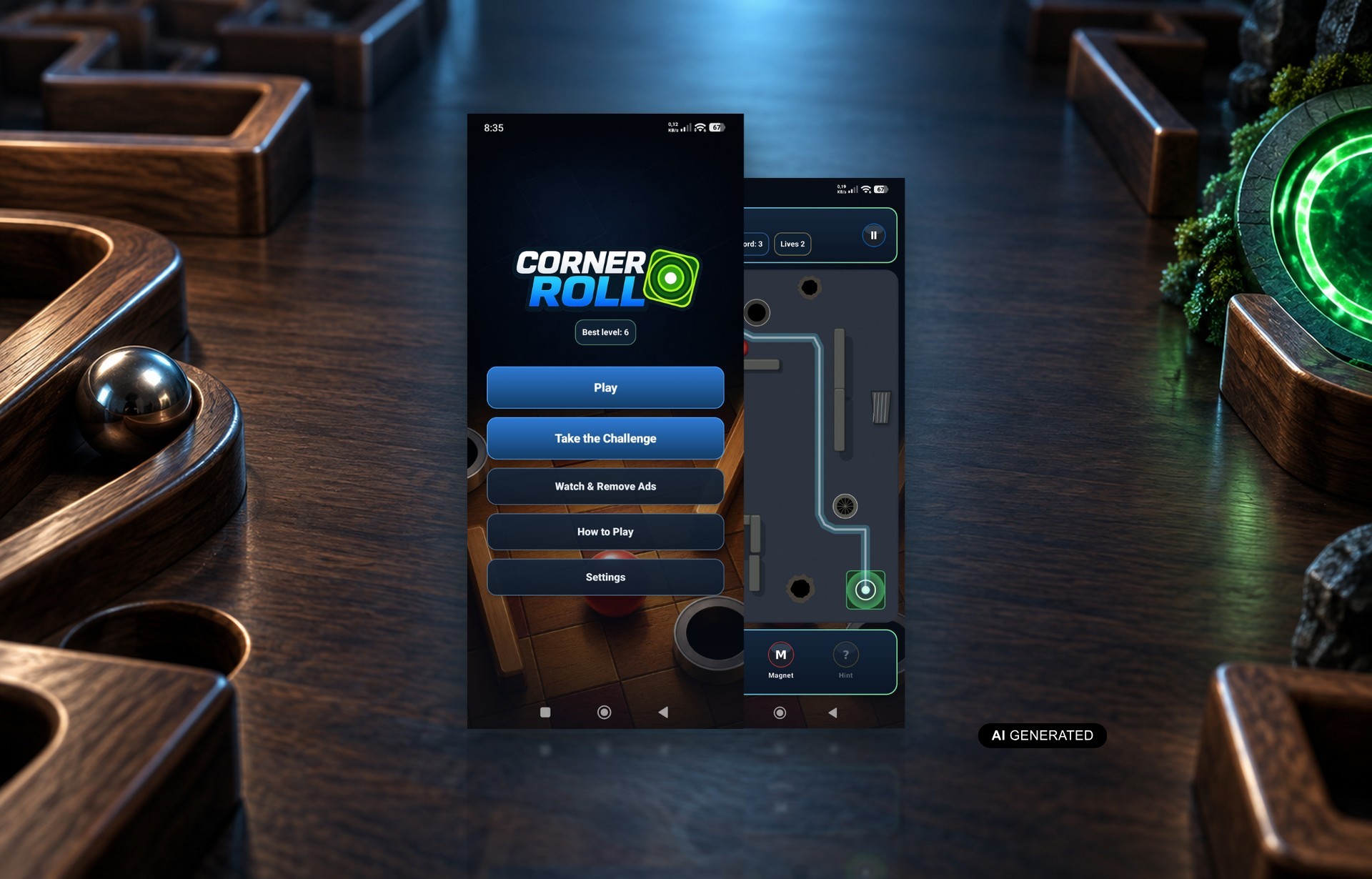
Corner Roll is a free arcade game for Android, a ball-in-maze puzzle steered by tilting your phone. It was created by BeeClear – a marketing agency that also builds its own mobile apps and WordPress plugins. Every board in the game is randomly generated, and yet it can always be completed. Before a layout ever reaches your screen, an algorithm checks that a comfortable route leads from the start to the goal. Here’s how that check works and why it changes the way you play.
Table of contents
- Why can a random board in a ball-maze game feel unfair?
- How does Corner Roll check whether a board can be completed?
- Why does corridor width matter for tilt-based steering?
- What happens when a generated layout doesn’t meet the requirements?
- How does difficulty increase if every stage has to be completable?
- Does the surface change how you guide the ball?
- How does the hint reveal a safe route to the goal?
- How do you set your own challenge in Take the Challenge mode?
- How do you start playing Corner Roll?
Why can a random board in a ball-maze game feel unfair?
A random board in a ball-maze game feels unfair when a chance arrangement of walls and holes seals off the way to the goal. The player has no way of knowing whether it was their own precision that failed, or the maze itself. The next attempts end in the same spot, and frustration grows with every lost ball. Instead of the satisfaction of quick reflexes, all that’s left is the feeling that the game is cheating.
Randomization, on the other hand, keeps things fresh. You never memorize a route by heart, because every stage looks different. The trick is combining both worlds – variety and the certainty that a way out exists. Only then does randomness delight instead of irritate. That’s exactly the problem Corner Roll’s board-building mechanism solves.
How does Corner Roll check whether a board can be completed?
Corner Roll checks every generated layout before it lets you play it. BFS, a pathfinding method (breadth-first search), is what this check is built on. Step by step, it examines every available passage and must find a path from the starting corner to the green portal in the opposite corner. The ball starts in one of four corners, chosen at random, so the goal ends up somewhere different each time.
A path merely existing isn’t enough, though. The game requires a corridor about 1.8–2.2 ball diameters wide. That way the route isn’t a slit that only a perfect move could squeeze through. You get room for a small correction of your tilt, and the outcome comes down to your control over the ball.
The layout being checked has a format close to a phone screen’s 9:16 ratio. The corridors are built from straight beams, L-shaped corners and T-junctions. Themed obstacles and holes the ball can fall into stand between them. BFS accounts for all of these elements, so no obstacle can ever cut off the way to the goal.
Why does corridor width matter for tilt-based steering?
Corridor width matters because tilt-based steering is never perfectly steady. Your hand trembles, the phone wobbles a little, and the motion sensor picks up noise along the way. Corner Roll smooths that signal with a low-pass filter, so the ball doesn’t jitter from tiny disturbances. A corridor nearly two ball diameters wide adds further margin for human imprecision on top of that.
You can set steering sensitivity to low, medium or high. Low favors calm, steady guiding, while high rewards quick reactions. On a device without an accelerometer, the game switches automatically to finger-drag steering on the screen. The certainty that a route exists holds equally for both control methods.
What happens when a generated layout doesn’t meet the requirements?
A generated layout that doesn’t meet the requirements gets thrown out and rebuilt from scratch. The mechanism first tries again with stricter route requirements. If that isn’t enough, it relaxes the criteria and places fewer obstacles. As a result, the game never hands you a stage that can’t be beaten.
The whole process happens behind the scenes, before you ever see anything. You don’t wait for approval, and you never see the rejected versions. You simply get a new set of walls, obstacles and holes, with a guaranteed path to the portal. So every failure tells you something about your own move, never about a flaw in the randomization.
How does difficulty increase if every stage has to be completable?
Difficulty in Corner Roll rises because the route requirements change as you progress. The path gets longer, and the turns pile up with every portal you clear. Obstacles and holes are placed more densely, and the tilt-driven acceleration multiplier climbs gently. The ball reacts more sharply as a result, and your margin for error shrinks.
A guaranteed path doesn’t mean an easy game, though. It only means the challenge is fair. Falling into a hole costs one life and restarts the same stage. In Play mode you get three lives for the whole run, and once they’re gone you’re back to level 1. The game saves your record and shows in real time how far you are from beating it.
This setup drives a classic “just one more try” loop. Since you know a way through exists, every failure invites another attempt. Seeing exactly how far you are from your record gives you a concrete goal for the next session. Short stages mean the next attempt takes only a moment.
Does the surface change how you guide the ball?
The surface changes how you guide the ball, because each of the five has its own physics. The game randomly picks bathroom tile, living-room wood, office carpet, garage concrete or slick dark marble. The surface affects friction, sliding and how strongly the ball reacts to a tilt. On concrete, the ball additionally jitters at random, as if rolling over a rough floor.
Each setting also has its own set of obstacles. In the garage you dodge a traffic cone, a plank, a tire and a toolbox; in the living room – an armchair, a book, a plant and a remote. The same route on marble demands a different feel than on carpet. The gameplay stays fresh even as the core rule stays simple: roll the ball to the portal.
How does the hint reveal a safe route to the goal?
The hint in Corner Roll lights up a safe route to the goal for a few seconds. It’s a natural extension of the completability guarantee, since the game already knows where the path runs. It comes in handy in long, winding mazes when the right corridor isn’t obvious at a glance. Alongside it are two more power-ups, each with a single charge per level:
- the shield protects you once from falling into the nearest hole and pushes the ball to a safe distance,
- the magnet gently pulls the ball toward the goal for a few seconds,
- the hint briefly draws the safe path so you can memorize it.
None of these extras play the game for you. The magnet supports your steering, but it won’t carry the ball to victory by itself. Choosing the right moment to use a charge becomes a small tactical decision. A shield used near tightly packed holes can save a precious life. The simple core of the gameplay stays untouched.
How do you set your own challenge in Take the Challenge mode?
You set your own challenge in Take the Challenge mode before you start, using three sliders. The difficulty scale affects, among other things, the required route complexity that the algorithm checks. Lives and time reset here with every level, and running out of time counts the same as falling into a hole. Here’s what you control:
| Slider | Range | What it affects |
|---|---|---|
| Difficulty scale | 1 to 10 | the pace of rising difficulty, the density of obstacles and holes, and route complexity |
| Number of lives | 1 to 5 per level | your margin for error in each maze |
| Time limit | 30 to 180 seconds, in 30 s steps | time pressure and the feel of the time attack |
Low difficulty with five lives gives you a calm, casual playthrough. High difficulty, one life and 30 seconds turn the game into a brutal sprint. Even at the highest settings the same rule applies – every maze can be completed.
How do you start playing Corner Roll?
You can start playing Corner Roll after downloading the app for free from Google Play. The game runs locally and offline, apart from showing ads, and doesn’t require an account. The interface supports 31 languages, including Polish. A single board takes anywhere from a few to a few dozen seconds, so a short break at work or a commute is enough.
We cover all the game’s modes and features in detail on the Corner Roll page. You’ll also find screenshots of the different board themes there. Download the game, pick a mode, and tilt your phone to guide your first ball to the portal. How many levels will you clear before you fall into a hole? Find out, because here only precision loses, never the board.